The Short Answer
The slow blink — when a cat half-closes its eyes and opens them slowly — is a non-threat signal that communicates relaxation, trust, and positive affect. Research published in Scientific Reports in 2020 confirmed that cats slow-blink more in response to owners who slow-blink at them, and that humans slow-blinking at unfamiliar cats increases the cats’ willingness to approach. It is the closest thing to a smile that a cat produces. You can do it back.
The Most Understated Compliment in the Animal Kingdom
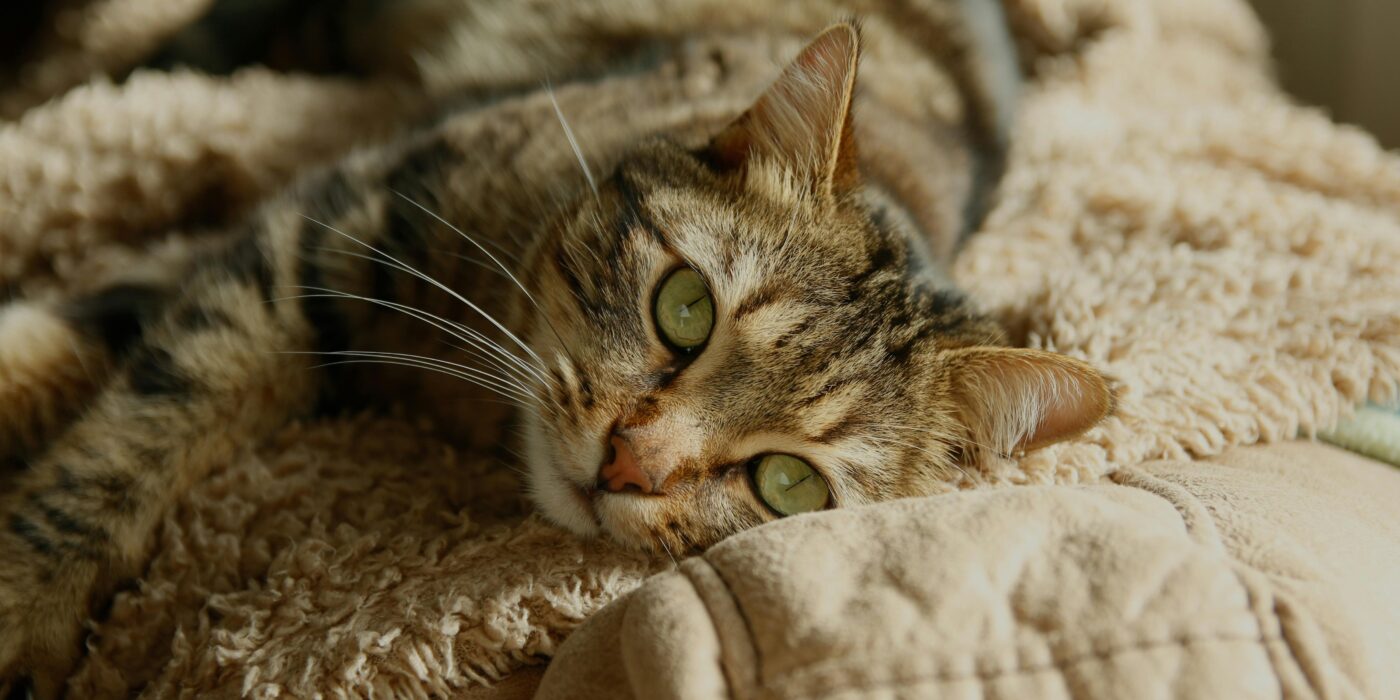
You’re sitting quietly. Your cat is across the room, watching you. It holds your gaze for a moment, then its eyes go half-shut — slow, deliberate, languorous — and open again.
Cat owners have been calling this the “cat kiss” for generations, largely on intuition. In 2020, researchers at the University of Sussex decided to find out whether the intuition was right. The answer was yes.
The Study That Proved It
Tasmin Humphrey and Professor Karen McComb at the University of Sussex published a study in Scientific Reports (2020) that directly tested the slow blink in two experiments:
Experiment 1: Owners were asked to slow-blink at their own cats while maintaining a neutral face. Control condition: the owner was present but did not slow-blink. Result: cats slow-blinked more in response to owners who slow-blinked at them than in the control condition.
Experiment 2: An unfamiliar experimenter slow-blinked at cats the experimenter had no prior relationship with. Result: cats were significantly more likely to approach the experimenter after slow-blinking than after a neutral gaze.
The conclusions were clear: slow blinking is a communicative signal with positive valence (emotional sign value) for cats, it travels in both directions (human → cat and cat → human), and it influences cat behaviour — cats are more willing to approach strangers who slow-blink at them.
The researchers proposed that the slow blink communicates the absence of threat and positive emotional state, analogous to what a relaxed, slightly narrowed expression communicates in human social signalling.
What Sustained Direct Gaze Means in Cat Language
To understand why the slow blink is positive, you need to understand what its opposite means.
In feline communication, sustained direct eye contact is a threat signal. Cats staring at each other without blinking or looking away are expressing challenge or dominance. It’s confrontational. Two cats in a staring contest are having a negotiation about who blinks — i.e., backs down — first.
When a cat looks at you and then slowly closes and opens its eyes, it’s doing the opposite of a staring contest. It’s deliberately softening its gaze, demonstrating that it is relaxed enough to reduce visual vigilance in your presence, and signalling non-threat. In cat communication terms, it is specifically un-staring at you.
That’s the context in which the slow blink registers as a positive social signal: it’s the absence of the threatening behaviour, performed deliberately.
How to Slow-Blink at Your Cat
The mechanics matter. An awkward or too-deliberate slow blink can look more like aggressive staring than a social signal. The key elements:
- Start with a relaxed, soft face — not intense, not leaning forward
- Allow your gaze to be soft — not hard-focused, more like looking at someone you’re very comfortable with
- Let your eyes close about halfway, hold briefly, then open slowly
- Look slightly away as they open — not turning away fully, just softening the directness
The whole thing takes about 2-3 seconds. A too-fast blink looks like a regular blink. A too-slow, too-intense version can look like you’re staring with pauses.
Natural is the goal. If you’re overthinking it, you’re doing it wrong.
Will Every Cat Respond?
Not every cat will respond dramatically, and some cats — particularly those that are less people-oriented or in unfamiliar environments — may not respond at all immediately. The research showed significant results at the population level; individual variation is real.
Factors that improve the chances of a reciprocal slow blink:
– You’re in a familiar, calm environment
– The cat is relaxed (not alert, not hiding, not eating)
– You have an established positive relationship with the cat
– You’re at a comfortable distance — not looming over the cat
McComb and Humphrey note that the effect with unfamiliar cats was meaningful but smaller than with owner-familiar cats. Trust is a precondition, even if a partial one.
Other Things That Go Alongside Slow Blinking
Cats that are in a positive, relaxed social state often combine slow blinking with:
– Softened posture — body relaxed, not tense
– Partially or fully closed eyes while at rest — the extreme end of the non-vigilance signal
– Turned-away gaze — looking at you but not directly, which is another softened social signal
– The “loaf” position — paws tucked under the body, maximum heat conservation, minimum emergency-exit readiness
A cat that slow-blinks at you and then tucks its paws under is in about as relaxed and positive a social state as a cat gets.
Quick Answers to Everything Else
My cat blinks at me but not the slow, deliberate kind — just regular blinking. Does that count?
Regular blinking is just eye maintenance. The communicative slow blink is distinguishably different — it’s slower, often accompanied by a slight relaxation of the facial muscles and a half-closure rather than a full blink. You’ll know the difference once you’ve seen it.
Can I use slow blinking with a cat I’ve never met?
Yes, and the research suggests it can increase their willingness to approach you. From a non-threatening posture, with slow blinks, many unfamiliar cats will approach more readily than with neutral gaze. It’s a useful tool for meeting new cats.
My cat stares at me without blinking. Should I be worried?
Probably not worried — it may be interested in what you’re doing, tracking movement, or just fixing on you as the most interesting thing in the environment. Staring between cats is a threat signal; cats staring at humans often isn’t, because the inter-species communication context is different. That said, a slow blink back is a gentle way to soften any tension that might be present.
The Bottom Line
The slow blink is a scientifically confirmed positive social signal — the cat communicating, in the most cat-like way possible, that it trusts you, it’s comfortable, and it’s content to be in this moment with you.
You can do it back. It works. The cat kiss is real.
Related Posts
- Why Does My Cat Head-Butt Me?
- How to Read Your Cat’s Body Language
- Does My Cat Actually Love Me?
- Why Does My Cat Stare at Me?
Sources:
Humphrey, T. & McComb, K. (2020). The role of cat eye narrowing movements in cat-human communication. Scientific Reports, 10, 16503.
Bradshaw, J. (2013). Cat Sense: How the New Feline Science Can Make You a Better Friend to Your Pet. Basic Books.
Sources & References
- Horowitz, A. (2009). Inside of a Dog. Scribner.
- Bradshaw, J. (2013). Cat Sense. Basic Books.
- McConnell, P. (2002). The Other End of the Leash. Ballantine Books.
All factual claims on Pawsidor trace to peer-reviewed research, university studies, or books by credentialed animal scientists. Learn about our editorial standard →