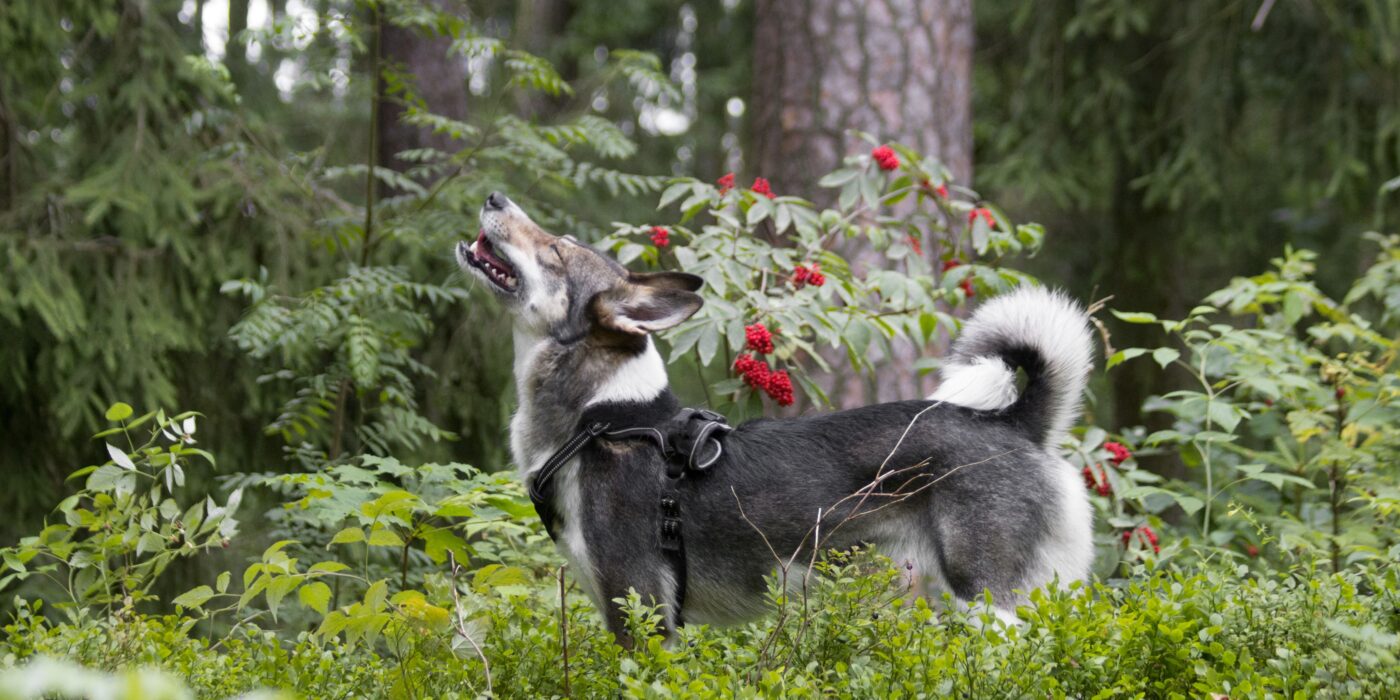
Why Do Dogs Howl? The Real Reasons Behind This Ancient Behavior
If you have ever watched your dog throw its head back and release a long, haunting sound at seemingly nothing, you already know the question: why do dogs howl? Whether the trigger was a passing siren, a song on the radio, or the moment you walked out the front door, howling is one of the oldest and most instinctive behaviors in the canine world. Understanding why do dogs howl, what each type of howl means, and when it signals a real problem will make you a significantly better dog owner. This guide covers everything.
Why Do Wolves Howl? The Evolutionary Root of Dog Howling
To understand why do dogs howl, you have to start with wolves. Dogs are direct descendants of wolves, and howling is one of the behaviors that survived domestication almost completely intact.
Why do wolves howl? The short answer is communication across distance. Wolves use howling to rally separated pack members, announce their location to rival packs, coordinate during hunts, and reinforce social bonds within the group. A wolf’s howl can carry over several miles in the right conditions, making it far more effective than barking for long-range communication.
John Bradshaw, in Dog Sense, argues that dogs retained this wiring precisely because it remained useful after domestication. The target changed from wolfpack to human family, but the impulse is identical: something separated me from my group and I need to make contact. Patricia McConnell, certified applied animal behaviorist and author of The Other End of the Leash, describes it as fundamentally a social behavior about connection across distance.
Stanley Coren notes in How to Speak Dog that dogs actually howl in more contexts than wolves do, having added responses to human-made sounds, music, and emotional states that wolves never encounter. The behavior expanded rather than contracted through domestication.
Why Do Dogs Howl: The Six Main Reasons
Every howl has a specific cause. Once you understand the categories, you can read your dog’s howling accurately rather than guessing.
1. Response to Sound
This is the most common reason why do dogs howl and the most dramatic to witness. Certain frequencies, particularly long, sustained, high-pitched tones, trigger the howl response directly. The dog hears what sounds, to its ancient brain, like another animal calling out and responds in kind.
Sirens are the most common trigger, but the list also includes wind instruments, strings played with vibrato, harmonicas, and certain vocal styles. Some dogs respond to a remarkably specific range of sounds while ignoring others entirely. Huskies, Beagles, and Basset Hounds are particularly prone to sound-triggered howling due to their vocal breeding history.
2. Communicating Location to the Pack
When your dog howls as you leave the house, it is performing the wolf equivalent of calling out to a separated packmate: I am here, where are you? This is the pack-location call, and it is one of the primary reasons why do dogs howl when left alone.
Pure location calling is rhythmic and persistent but not panicked. It is distinct from separation anxiety, though the two can overlap. A dog doing location calling is waiting for a response. A dog in full separation anxiety is in distress, which shows up as destructive behavior, house soiling, and physical agitation alongside the howling.
3. Alert and Territorial Signaling
Dogs also howl to announce their presence to approaching strangers, human or animal. It is a longer-range, more sustained signal than barking: I am here. I am aware of you. Govern yourself accordingly. Larger and more wolf-like breeds tend to use this type of howl more frequently than smaller companion breeds.
4. Expressing Emotion
Dogs howl when excited, particularly hunting breeds catching a scent. They howl when lonely. They howl when in pain. Bruce Fogle highlights in The Dog’s Mind that pain-related howling tends to be sudden and sharp with no environmental trigger, and it is one of the clearest signals a dog gives that something is physically wrong. Howling from loneliness or boredom can develop into a habitual behavior in dogs left alone for extended periods.
5. Breed-Specific Vocal Behavior
Some breeds were selected specifically for their vocal range. Hound breeds such as Beagles, Bloodhounds, and Coonhounds were bred to bay and howl during hunts to communicate their position to hunters over long distances. Nordic breeds such as Huskies, Malamutes, and Samoyeds retain strong wolf-like vocal repertoires and howl freely as a form of everyday communication. Telling a Siberian Husky not to howl is like telling a Border Collie not to herd. You can manage it. You cannot eliminate it.
6. Medical Causes
Sudden onset howling in a dog that did not previously howl, especially in older dogs, can indicate cognitive dysfunction, pain, neurological changes, or hearing loss. Fogle notes that vocalization changes in senior dogs are among the earliest observable signs of canine cognitive decline. If your dog starts howling out of nowhere in its senior years, a veterinary check is warranted immediately.
Why Do Dogs Howl at Sirens?
This is one of the most searched questions about dog howling, and the answer is straightforward once you understand canine hearing.
Why do dogs howl at sirens? Because a siren sounds, to a dog’s auditory system, remarkably like a distant howl. The frequency range of emergency sirens overlaps significantly with the frequency range of canine howling. When your dog hears that rising and falling tone, the ancient wiring fires: something out there is calling, and the correct response is to call back.
This is pure instinct, not distress. Most dogs do not look anxious when they howl at sirens. They look engaged: tail up, ears forward, nose lifted. They are participating in what their brain registers as a howling exchange with another animal. The siren moves away, the howling stops, and the dog returns to normal with no apparent distress.
Why do dogs howl at sirens more than other sounds? Because sirens hit a sustained pitch in a frequency range that closely mimics canine vocalization. A car horn is too short and percussive. A siren is long, modulated, and rising, which matches the acoustic profile of a howl closely enough to trigger the response reliably across most dogs regardless of breed.
Why Do Dogs Howl at Night?
Why do dogs howl at night specifically, when they may be quiet all day? The answer is acoustic, not mystical.
Night is significantly quieter than day. Ambient noise from traffic, people, and activity drops substantially after dark, which means sound travels further. Your dog is hearing things at night that it simply cannot detect during the day: distant dogs howling several streets away, wildlife moving through the area, environmental sounds that carry across the silence.
When your dog howls at night it is almost always responding to something it can hear that you cannot. Dogs have a hearing range of approximately 40 Hz to 65,000 Hz compared to the human range of 20 Hz to 20,000 Hz. They are operating with significantly more acoustic information than you are, and at night that information becomes richer.
Some dogs also simply have stronger nocturnal vocal tendencies than others, particularly Nordic breeds and hounds that were historically used for night hunting. If nighttime howling is becoming a problem, rule out what the dog is hearing first before attempting behavioral intervention.
Why Do Dogs Howl When Left Alone?
Why do dogs howl when left alone is the question most likely to arrive via a concerned neighbor rather than personal observation.
Your dog has formed a social bond with you. When you leave, from the dog’s perspective, the pack has split. The evolutionarily appropriate response is to signal location and wait for the pack to reassemble. That is the howling your neighbors hear starting approximately two minutes after you close the front door.
Whether this requires intervention depends on severity and duration. Occasional howling that stops within five to ten minutes as the dog settles is normal behavior. Prolonged howling lasting thirty minutes or more, combined with other distress signs such as destructive behavior, elimination indoors, and physical agitation like pacing or drooling, indicates genuine separation anxiety rather than simple location calling.
The distinction matters because the interventions are different. Location calling responds well to enrichment: puzzle feeders, Kong toys, sniff-work before departure, and gradual desensitization to departure cues. True separation anxiety often requires a structured behavior modification program, sometimes with veterinary support including medication, rather than simple enrichment.
If your dog shows signs of distress beyond howling when alone, read our guide on signs your dog is in pain to understand what physical distress signals look like, then discuss the behavioral picture with your vet.
Why Do Dogs Howl at Certain Songs?
Because certain songs hit the right frequencies and sound like an invitation to join in.
Instruments in the mid-to-high range, particularly sustained tones from wind instruments, strings played with vibrato, and certain vocal styles, can trigger the howl response. Some dogs are wildly specific about which songs set them off and which ones leave them completely unmoved. The dog that howls along to a harmonica while ignoring a rock song is making a precise acoustic judgment, not a random one.
This is one of the more charming expressions of why do dogs howl. The dog is not suffering. It is performing alongside you, engaging in what its ancient brain registers as a communal howl.
How to Reduce Excessive Howling
First decide whether you actually need to. Occasional howling is normal, healthy behavior and part of having a dog. Attempting to eliminate it entirely is unrealistic and frustrating for both of you.
If it is a genuine problem:
- For separation howling: Work on departure desensitization. Practice leaving for short periods and gradually extend them. Puzzle feeders, Kong toys, and sniff-work redirect the dog’s attention and lower arousal before you leave. In persistent cases, a certified behaviorist is worth consulting rather than guessing.
- For response howling (sirens, music): If it bothers you, train an interrupter cue. Teach a quiet command and reward compliance consistently. If it does not bother you, there is no reason to intervene at all.
- For breed-specific howling: Management, not elimination, is the realistic goal with Nordic and hound breeds. Adequate physical and mental exercise reduces the frequency and intensity of vocal behavior in high-drive dogs significantly.
- What never to do: Do not punish howling harshly. It is instinctive communication. Punishing it without addressing the underlying cause creates anxiety without solving the behavior and typically makes things worse.
Quick Answers: Why Do Dogs Howl?
Why do dogs howl at the moon?
Why do dogs howl at sirens but not other loud sounds?
Is it normal for my dog to howl every time I leave?
Why do dogs howl in their sleep?
Do male dogs howl more than female dogs?
Can howling mean my dog is in pain?
Sources
- Horowitz, A. (2009). Inside of a Dog: What Dogs See, Smell, and Know. Scribner.
- McConnell, P. (2002). The Other End of the Leash. Ballantine Books.
- Coren, S. (2000). How to Speak Dog: Mastering the Art of Dog-Human Communication. Free Press.
- Fogle, B. (1990). The Dog’s Mind: Understanding Your Dog’s Behavior. Howell Book House.
- Bradshaw, J. (2011). Dog Sense: How the New Science of Dog Behavior Can Make You a Better Friend to Your Pet. Basic Books.
- Harrington, F.H. & Mech, L.D. (1979). Wolf howling and its role in territory maintenance. Behaviour, 68(3-4), 207-249.
- American Kennel Club: Why Do Dogs Howl?
- Merck Veterinary Manual: Behavioral Problems of Dogs
- Harrington & Mech (1979) via PubMed
Keep Reading: Is My Dog in Pain? Signs to Watch For | Why Does My Dog Follow Me Everywhere?
Sources & References
- Horowitz, A. (2009). Inside of a Dog. Scribner.
- Bradshaw, J. (2013). Cat Sense. Basic Books.
- McConnell, P. (2002). The Other End of the Leash. Ballantine Books.
All factual claims on Pawsidor trace to peer-reviewed research, university studies, or books by credentialed animal scientists. Learn about our editorial standard →