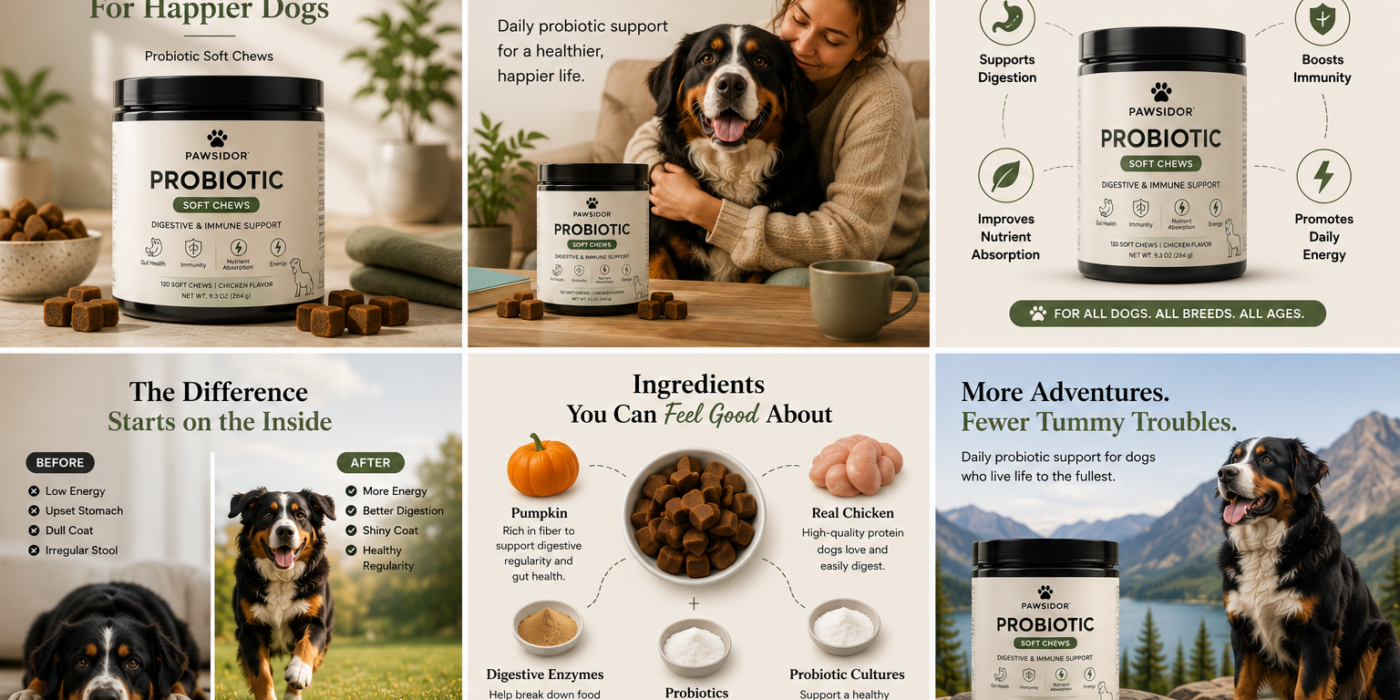
Probiotics for Dogs and Cats: What the Science Actually Shows
Your dog just finished a round of antibiotics. Your cat has had loose stools for three days. Your vet mentions the gut microbiome and you nod, but you are not entirely sure what that means or what to do about it. This article answers all of it: what probiotics for dogs and cats actually do, which situations call for them, what the peer-reviewed research says, and how to pick a supplement that works.
What Are Probiotics?
Probiotics are live microorganisms that, when consumed in adequate amounts, provide measurable health benefits to the host. In dogs and cats they are most commonly delivered as soft chews, powders, or capsules added to food.
The gut of a healthy dog or cat contains trillions of microorganisms known collectively as the gut microbiome. This ecosystem governs far more than digestion. It regulates immune response, produces key nutrients, protects against pathogens, and communicates directly with the brain via the gut-brain axis. When this ecosystem falls out of balance, a state researchers call dysbiosis, the effects ripple into every major body system.
Probiotics work by restoring and maintaining a healthy balance of beneficial bacteria, counteracting the cascade of problems that dysbiosis triggers.
Why Gut Health Is the Foundation of Pet Health
Seventy percent of the immune system is located in the gut, housed within the gut-associated lymphoid tissue, the largest immune organ in the body. The gut also produces neurotransmitters including serotonin, which influences mood and behaviour. Its lining acts as a physical barrier preventing pathogens, toxins, and undigested particles from entering the bloodstream. And gut bacteria produce short-chain fatty acids like butyrate, which fuel intestinal cells and suppress inflammation throughout the body.
When gut health deteriorates, the consequences show up everywhere: loose stools, dull coat, low energy, recurrent infections, food sensitivities, and anxious behaviour. A quality daily probiotic is one of the highest-return investments you can make in your pet’s health.
What the Research Actually Shows
A 2025 review published in Veterinary Sciences covering research from the Chinese Academy of Agricultural Sciences concluded that probiotics exert significant positive impacts on gut health in pets, including alleviating intestinal inflammation, regulating gut microbiota balance, and relieving diarrhoea. The same review found that probiotics aid in preventing obesity, enhancing nutrient digestibility, and exhibit antiviral and antioxidant activity. Read the full peer-reviewed review at MDPI Veterinary Sciences.
A separate systematic review focused on cats, published through NCBI, found that probiotic strains such as Lactobacillus acidophilus altered fecal microbiota and increased the presence of beneficial bacteria, with positive effects on both gut health and immune function. Read the feline probiotic review at NCBI.
Cornell University’s College of Veterinary Medicine describes probiotics as a well-established therapy for gastrointestinal upset, noting that more recent research has extended their proven benefits to urinary tract infections, immune disorders, and anxiety. Read Cornell Veterinary’s guide on the power of probiotics.
Seven Proven Benefits of Probiotics for Dogs and Cats
1. Better Digestion and Stool Quality
This is the most well-established benefit and the one most pet owners notice first. Probiotics restore healthy gut flora disrupted by stress, diet changes, illness, or antibiotics. The result is more consistent stools, reduced gas and bloating, fewer episodes of diarrhoea, and better regularity overall. The Purina Institute notes that probiotics restore balance in the gut microbiota and improve stool consistency, with particular benefit for cats with chronic gastrointestinal sensitivity.
2. A Stronger Immune System
Because the majority of immune function is gut-based, a healthier gut produces a stronger and more calibrated immune response. Probiotics increase immunoglobulin levels, suppress inflammatory markers, and enhance the activity of immune cells. Research published in Frontiers in Immunology found that compound probiotic supplementation improved canine immunity alongside feed intake and weight gain.
In cats, Bifidobacterium lactis has been shown to improve gut barrier function by reducing markers of gut permeability by over 20%, while increasing populations of beneficial Lactobacillus bacteria. Read the B. lactis in cats research at NCBI.
3. Healthier Skin and a Shinier Coat
The gut-skin axis is a real and well-studied communication pathway. Gut dysbiosis is directly linked to inflammatory skin conditions in both dogs and cats. A 2025 study on canine atopic dermatitis found that dogs with the condition had significantly lower gut microbial diversity compared to healthy dogs, and that probiotic administration effectively reduced symptoms by correcting that dysbiosis. Read the atopic dermatitis probiotic study at NCBI. Many owners report visible coat improvements within four to eight weeks of consistent daily supplementation.
4. Reduced Anxiety Through the Gut-Brain Axis
The gut-brain axis is a bidirectional communication network between the gut microbiome and the central nervous system, operating via the vagus nerve, hormone signalling, and neurotransmitter production. One strain in particular, Bifidobacterium longum BL999, has become the most studied psychobiotic in veterinary medicine. Clinical data shows it improved anxious behaviours in 90% of dogs studied, with measurable reductions in cortisol and heart rate. In cats, supplementation with BL999 has been shown to reduce stress responses including stress-triggered diarrhoea.
If your dog shows signs of separation anxiety or your cat reacts badly to travel or boarding, this is one of the most evidence-backed natural interventions available. For a full breakdown of what causes dog anxiety, read our article on why dogs follow their owners everywhere and the attachment science behind it.
5. Enhanced Nutrient Absorption
Probiotics produce digestive enzymes and short-chain fatty acids that improve how efficiently the gut processes and absorbs nutrients. A dog or cat with a well-balanced gut microbiome simply gets more from every meal. This is why probiotics are frequently combined with digestive enzymes in premium pet supplements. The two work synergistically: probiotics support the microbial environment, digestive enzymes directly assist nutrient breakdown.
6. Recovery After Antibiotics
Antibiotics are necessary but destructive to gut flora. They eliminate harmful bacteria but also wipe out beneficial strains, often resulting in diarrhoea, gas, and reduced immunity during and after treatment. Probiotic supplementation during and after antibiotic courses is one of the most evidence-backed applications of probiotics in veterinary practice. It repopulates the gut with beneficial bacteria and shortens the recovery window significantly.
7. Long-Term Chronic Disease Prevention
The 2025 Veterinary Sciences review highlighted probiotics’ documented potential to prevent and manage chronic diseases in dogs and cats, including obesity, inflammatory bowel disease, metabolic disorders, and immune-related conditions. A daily probiotic for a healthy pet is not overtreatment. It is maintenance of the system that underpins nearly everything else.
Dogs vs. Cats: Key Differences
Dogs and cats have meaningfully different gut microbiome compositions. Cats are obligate carnivores, meaning their microbiome is adapted primarily for protein digestion and carries less microbial diversity than a dog’s omnivorous gut. This means cats may respond differently to certain strains, and using a species-appropriate formulation matters.
Best strains for dogs: Lactobacillus acidophilus, Bifidobacterium animalis, Enterococcus faecium SF68, Bifidobacterium longum BL999, Bacillus coagulans.
Best strains for cats: Bifidobacterium lactis, Lactobacillus plantarum, Enterococcus faecalis, Bacillus licheniformis, Bacillus subtilis.
Human probiotics are not harmful to pets in small amounts, but they are not optimised for feline or canine gut ecosystems. Always choose a supplement formulated specifically for the species you are supplementing.
When Does Your Pet Need Probiotics?
Probiotics deliver the most noticeable benefit in specific situations, though they support any pet as a daily maintenance supplement:
- Diarrhoea or loose stools caused by stress, dietary change, or post-illness gut disruption
- During or after antibiotics to restore gut flora wiped out by treatment
- Anxiety or stress from travel, boarding, a new environment, or behavioural issues
- Skin conditions or dull coat including chronic itching or atopic dermatitis
- Post-surgery or post-illness as both events disrupt gut flora significantly
- Senior pets as microbiome diversity declines naturally with age
- Picky eaters or poor weight gain which may indicate low gut efficiency
- Daily maintenance for any healthy dog or cat
For dogs showing signs of pain, trembling, or unusual lethargy alongside digestive issues, read our article on why dogs shake and tremble to rule out other causes before assuming the gut is the problem.
What to Look for in a Pet Probiotic
Not all probiotics are equal. When evaluating a product, these criteria matter:
CFU count: At least 1 billion CFU per serving for dogs. Some dogs with chronic issues benefit from up to 10 billion. Start at half-dose for the first week to allow the gut to adjust.
Strain variety: Multi-strain products consistently outperform single-strain products in research. One study found short-chain fatty acid production increased only when dogs received a bacterial mixture, not a single strain.
Species formulation: Choose a product made specifically for your pet species. Feline and canine microbiomes require different strain profiles.
Palatability: A probiotic your pet refuses to eat is worthless. Soft chews with chicken or meat flavouring consistently achieve the highest daily compliance rates.
Shelf stability: Confirm the product maintains live CFU counts through its shelf life. Spore-forming strains like Bacillus coagulans are far more heat-stable than fragile Lactobacillus strains.
Digestive enzymes: A combined formula improves nutrient absorption beyond what either achieves alone. Look for protease, amylase, and lipase alongside the probiotic strains.
The gut is not just a digestive organ. In cats and dogs, it is the control centre for immunity, skin health, nutrient utilisation, and mental wellbeing. A quality daily probiotic is one of the most defensible investments you can make in your pet’s long-term health.
For a complete guide to what dogs can and cannot safely eat that affects gut health, read our article on whether dogs can eat fruits like strawberries, apples, and grapes.
Sources: MDPI Veterinary Sciences 2025 · NCBI Feline Probiotic Review · Cornell University Veterinary Medicine · Purina Institute · NCBI B. lactis in Cats · NCBI Atopic Dermatitis Study
Sources & References
- Horowitz, A. (2009). Inside of a Dog. Scribner.
- Bradshaw, J. (2013). Cat Sense. Basic Books.
- McConnell, P. (2002). The Other End of the Leash. Ballantine Books.
All factual claims on Pawsidor trace to peer-reviewed research, university studies, or books by credentialed animal scientists. Learn about our editorial standard →